
…at least for crypto trading. Be prepared for a long post.
First, I will try to explain how trading works. In simple term, a successful trade happens when two parties (buyer and seller) agreed on one price. Let’s imagine crypto market is the same as your local market. There are buyers (who will try to buy at low price as possible), and there are sellers (who will try to sell at high price as possible). If either parties unwilling to make some compromise (either buyer willing to accept higher price, or seller willing to accept lower price), then there won’t be any trade happens. But when either one willing to compromise, trade will happens.
When the price of a coin drops, what actually happens is a lot of sellers are willing to sell at lower prices for whatever reasons (stoploss, take profit, war break out, or many other reasons). When the price of a coin rises, that means a lot of buyers are willing to buy at higher prices for whatever reasons (investment, speculative, or others).
The issue with any indicator in general is that you are trying to turn those trading actions that were done by multiple people with multiple independent subjective reasons into a single formula that only take candles’ OHLCV values. You are reducing those millions independent reasons into one single formula. You are also making an assumption that when similar indicator value happens in the future, the market will react the same way as in the past. But we all know that that’s will never be the case. For starter, those people who traded (let’s say) yesterday, might not trade again today nor tomorrow or in one year. You would have different traders at the market with different strategies with different macro situations (politic, economy, etc). That means the market most likely would react differently on what seems to be similar price movements.
That’s why despite how long or complicated the formula of an indicator is, they are as useless as simple indicators. They can’t and won’t ever really take into account the real reasons of why price moves the way they moves. You are just trying to put random pegs into random holes. At some times it will fit, at other times it won’t fit.
The same reasons above can be applied to backtest as well to explain why a good backtest result won’t ever guarantee future profit. You can try to do backtest on a 4 years data, it won’t greatly increase your chance of future profit compared to backtest of only 1 year data. You are testing your strategy based of past trades done by traders who might or might not still trading nowadays, and even if they are still trading now, they might be using different strategies now. And as said above, the macro situations might be different as well. That makes past result won’t be reproduceable in the future.
Let’s use the example from this post to show how same traders using different strategies would impact trades differently. Depending on what B and C does, A’s trade will have different end result. That means once either B and/or C change their strategy, or B and C are replaced by D and E which have their own strategies, your past backtest result becomes completely irrelevant.
There is no law that requires traders to keep using only one strategy for their entire trading journey, which means you shouldn’t expect that whatever happened in the past would be repeated in the future. Simple example is just because a coin went up 10% after dropped -5%, it doesn’t means the next time it drops -5%, it’s guarantee to have a 10% rise again.
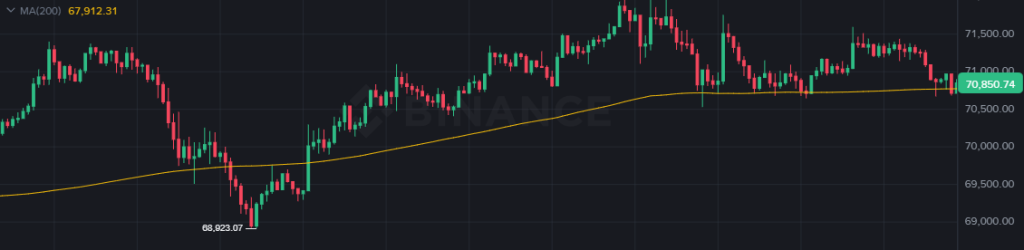
Let take a look at these 2 images. On image #1, after the BTC/USDT price dropped below SMA 200, it eventually rose up again
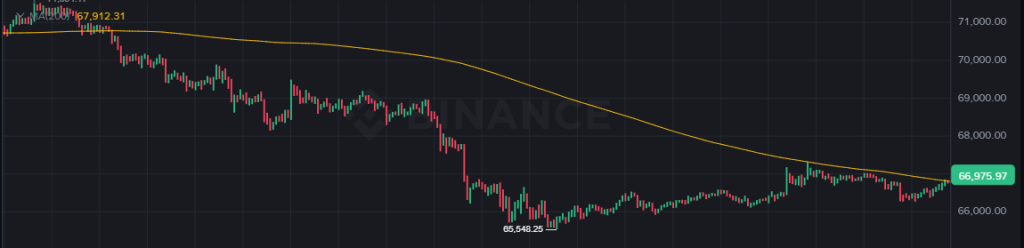
But then on image #2 with same pair but different time, the price never rose up after dipped below SMA 200
You might say “Then just add more indicators”. Sure, that might help, but in reality, you are just adding uncertainty on top of other uncertainties. Multiple uncertainties doesn’t make a single certainty. What usually happens is either you ends up with
- Very safe strategy, one that rarely trade on 99% of market, and only trade on that rare 1% condition (for example a very big and sudden market change, either up or down). This type of strategy usually can last long, but its low profit usually would deter users from having such strategy
- Very loose strategy, that trades at high numbers, based of past behaviors. This type of strategy usually won’t last long, but most users would gravitate towards this strategy due to the supposed profit potential.
- Strategy that is placed in between the first two types. Depending on which side this strategy is closer to, will influence how long it would last.
For personal experience of 4+ years at time of writing this, if you want to still use indicator(s) and/or do backtest, your strategy must aim for low trade side of the trading triangle. Whether you would go on high win % or high average profit % is up to you. But low trade count is a must. If you are still aiming for high trade count, no matter if you follow the trading triangle, your strategy will never survive long-term.
You might ask, then how come those “traders” that sells their strategies can offers big profits? First of all, if you notice, all of them only post backtest results of the strategies. They never post their real live trading results, especially long-term trading result. As I have explained above, having great backtest result is easy. You are dealing with fixed known data. Having bigger number of pairs increase the difficulty a little bit, but the data are still fixed and known. After a backtest run, if the result is bad, you can tweak some logics to take care of the bad trades, and the backtest result will turned to be great. Live trades won’t work like that. After having bad trade, even if you have tweaked the strategy to deal with that bad trade, there is no guarantee you can avoid/handle new bad trade in the future. Different market, different traders, different situation would give different market reactions.
That’s why I still believe doing manual trading will give you better profit since you can take into account external factors, such as world news, into your trading consideration, which usually influence market more than just some indicators’ value.
[…] Backtest and indicator are overrated […]